

Jeep Wrangler Suspension Parts Diagram and Jeep TJ Lift Kit - Rustys off Road
Ngày đăng: 14-10-2025 |
Ngày cập nhật: 14-10-2025
Is Your Stock Jeep Tire Carrier Putting Your Tailgate at Risk? Here’s What You Need to Know
![]()
When you depend on your Jeep for trail days and weekend getaways, every modification matters. Tailgates and stock Jeep tire carriers often carry more weight than they were designed for. This post examines common concerns, highlights product solutions, and explains how Rusty’s Off-Road approaches robust design so owners can make informed choices.
Why the carrier itself matters
A factory carrier is built to meet original equipment tolerances. Over time, heavier wheels and tires can increase stress on hinges, latches, and the tailgate structure. Rusty’s offers a dedicated jeep tire carrier option that was developed with durability and simplicity in mind. Our product pages discuss the carrier’s design goals and availability for specific Wrangler years.
A stronger carrier can reduce added stress, but the overall system (hinges, latch, tailgate structure) must be considered together for optimal results.
Q2 Does Rusty’s make carriers for older and newer Wranglers?
Rusty’s offers carriers and related rear-end hardware tailored to specific model ranges; check product listings for exact fitments.
Q3 Do I need to change my suspension if I install a much larger tire?
Heavier and larger tires alter dynamics. Many owners pair tire upgrades with suspension adjustments to preserve alignment and handling.
Q4 Are larger carriers like those for 40" tires bolt-on?
Some large-tire carriers are designed as bolt-on replacements; others may require additional bumper or frame brackets depending on the vehicle and tire size.
Q5 Where can I find part specifics and fitment info?
Our Product pages provide descriptions, fitment notes, and images to help match parts to your vehicle and use case.
Upgrade Your Jeep’s Rear End Today
Rusty’s Off-Road is focused on practical, durable solutions for Jeep owners. If you’re considering an upgrade, Review Jeep TJ lift kit options, carriers, suspension kits, and related hardware, then contact our team for specific fitment guidance. Make the smart choice: match components, keep it simple, and build a rear end that works as hard as you do.
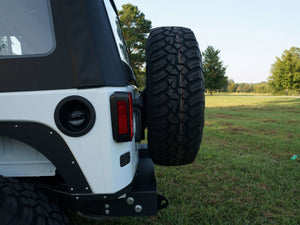
When you depend on your Jeep for trail days and weekend getaways, every modification matters. Tailgates and stock Jeep tire carriers often carry more weight than they were designed for. This post examines common concerns, highlights product solutions, and explains how Rusty’s Off-Road approaches robust design so owners can make informed choices.
Why the carrier itself matters
A factory carrier is built to meet original equipment tolerances. Over time, heavier wheels and tires can increase stress on hinges, latches, and the tailgate structure. Rusty’s offers a dedicated jeep tire carrier option that was developed with durability and simplicity in mind. Our product pages discuss the carrier’s design goals and availability for specific Wrangler years.
Stock carriers vs. larger wheel fits
Off-roaders often move to larger tire sizes for ground clearance and traction. When a larger tire is mounted, the carrier’s leverage on the tailgate increases. Owners who run oversized setups sometimes opt for a 40" tire carrier to handle the size and mounting requirements more cleanly.How lift changes loading
Installing a lift changes wheel position, swing arc, and clearances. A well-matched lift and carrier combination reduces awkward loads on hinges. Rusty’s carries lift and long-travel components designed for TJ and other Wrangler platforms, which factor into overall vehicle geometry.Consider fitment and simplicity
A straightforward mounting approach minimizes failure points. That’s a core design principle behind many Rusty’s products, including their mounting brackets and carriers. If you prefer a no-nonsense solution that focuses on strength, look for options built around that same philosophy.When a lift and carrier interact
When you combine our Jeep TJ lift kit with other modifications, the effective strain on the rear hardware can change. Rusty’s offers TJ suspension and long-travel kits that help owners configure their Jeep for heavier tires while maintaining reliable handling and support.Structural considerations for rear mounts
Beyond hinges, the tailgate’s internal structure and latch points are where most stress concentrates. Reinforced carriers and properly designed frame mounts distribute load away from thin sheet metal and onto stronger chassis points. Rusty’s product line emphasizes this kind of reinforcement in several of its upgrade kits.Planning around large tires
If your build calls for a 40" tire carrier, plan for the full package: correct carrier, compatible bumper, and suspension setup. Large tires are not just bigger; they change the way the rear of the vehicle behaves on and off-road. Pick components that were engineered to work together.Suspension basics and documentation
Knowing the layout of your suspension helps when integrating heavier wheels or carriers. A reliable Jeep Wrangler suspension parts diagram can clarify where to make changes, and which components are most affected by added rear weight.Product choices at Rusty’s
Rusty’s product assortment includes carriers, steering upgrades, and suspension kits intended for various Wrangler and Cherokee platforms. Their offerings reflect an emphasis on strength and practical engineering, so owners can choose compatible parts when modifying their rear setup.Ease of installation and serviceability
A carrier that’s easy to service matters. Look for carriers that allow access to latch mechanisms and provide straightforward mounting hardware. Rusty’s descriptions and product images aim to communicate these practical details so purchasers know what they’re getting.Matching carrier choice to vehicle use
Trail rigs and daily drivers have different needs. If you trail hard and run big tires, a purpose-built jeep tire carrier may be a better match than a stock unit. Purpose-built carriers are intended to integrate with other upgrades and reduce stress concentration on the tailgate.Final design thought before you buy
Think of the carrier as part of a system: tires, bumper, hinge, latch, and suspension all interact. If you’re upgrading to a Jeep TJ lift kit or moving to much larger rubber, consider the carrier and rear support components together rather than in isolation. That way, you avoid the patchwork approach and get a cohesive solution.Frequently Asked Questions
Q1 Will a stronger carrier eliminate tailgate sag?A stronger carrier can reduce added stress, but the overall system (hinges, latch, tailgate structure) must be considered together for optimal results.
Q2 Does Rusty’s make carriers for older and newer Wranglers?
Rusty’s offers carriers and related rear-end hardware tailored to specific model ranges; check product listings for exact fitments.
Q3 Do I need to change my suspension if I install a much larger tire?
Heavier and larger tires alter dynamics. Many owners pair tire upgrades with suspension adjustments to preserve alignment and handling.
Q4 Are larger carriers like those for 40" tires bolt-on?
Some large-tire carriers are designed as bolt-on replacements; others may require additional bumper or frame brackets depending on the vehicle and tire size.
Q5 Where can I find part specifics and fitment info?
Our Product pages provide descriptions, fitment notes, and images to help match parts to your vehicle and use case.
Upgrade Your Jeep’s Rear End Today
Rusty’s Off-Road is focused on practical, durable solutions for Jeep owners. If you’re considering an upgrade, Review Jeep TJ lift kit options, carriers, suspension kits, and related hardware, then contact our team for specific fitment guidance. Make the smart choice: match components, keep it simple, and build a rear end that works as hard as you do.
Click here to read more
Thông tin liên hệ
: rustysoffroad
:
:
:
:
