




238 x 160
Bookcase Ergonomics: Set Shelf Heights for Easy Access
Most people blame a “messy office” on lack of discipline. In reality, the shelf heights are often wrong. If the books you use every day sit too high, too low, or behind heavier items, you will not put them back. The result is a pile on the desk, cables everywhere, and a workspace that feels busier than it should.
Bookcase ergonomics is simply the practice of placing items where the body can reach them without stretching, bending, or shuffling ten things out of the way. Get the shelf spacing right and storage almost runs itself.
The Core Bookshelf Height Zones
A good bookshelf is not one long row of equal gaps. It is divided into zones based on how often you use the item.
The most useful zone is roughly between the desk surface and eye level. This is where daily references, current notebooks, folders, and the two or three books you actually open should live. You should not have to stand fully or lean sideways to reach them.
Above that sits the occasional zone. Use it for manuals, backups, decorative objects, and books you consult monthly. Higher shelves are fine here because access is rarer.
Below the desk zone is the weight zone. Heavy art books, lever-arch files, storage boxes, and printers belong low. This keeps the centre of gravity down and stops the shelf from feeling top-heavy. It also saves your wrists — you lift heavy things with your legs, not by yanking them from head height.
Vernal bookcases support this layout because the shelves are adjustable. Most versions include three adjustable shelves, while the flip-door version includes two. Each shelf has around 22.5kg static load capacity, so the lower rows can safely hold heavier items without bowing.
Using an Open Bookcase Without Strain
An open bookcase looks inviting, but only if the spacing matches the contents. Fixed shelves often waste space: tall gaps for small paperbacks, or short gaps that reject large folders.
Adjustable shelves solve this. Vernal bookcases offer around ±64mm adjustment per shelf, which is enough to fine-tune a row for novels, then drop the next row for binders or storage baskets.
For ergonomics, follow a simple rule:
- Frequently used items: at seated or standing eye level
- Medium-use items: one shelf above or below
- Rare items: top shelf
- Heavy items: bottom shelf or closed cabinet below
Open shelving also benefits from “negative space”. Leave one gap empty near eye level. It gives the room breathing room and makes the useful items easier to grab because nothing is crammed edge-to-edge.
If the unit includes lighting, aim it at the daily-use zone. Vernal’s LED strip runs from 2700K to 6500K, so you can brighten the working shelves without flooding the whole wall.
Planning Office Storage Around Reach
Office storage is not only about capacity; it is about motion. Every unnecessary reach costs focus. A well-planned home office keeps the most-touched items inside a small arc around the chair.
Try this layout:
- Behind or beside the desk: open shelf for daily books
- Under or next to the desk: file drawer
- To the side: closed cabinet for clutter
- Higher up: archive items and display pieces
The shelf should not hold everything. If the bookcase becomes a dumping ground, the daily items get buried. Keep the open shelves light, and push the messy category into doors.
Vernal storage pieces are designed in the same aesthetic as the desk range, which helps the room feel ordered. But the bigger win is behavioural: when every item has a logical height, you stop searching for it.
Pairing Shelves with a 2 Drawer File Cabinet
Files should rarely live on shelves. Folders slide, slump, and collect dust. Paperwork belongs in drawers, ideally at arm height while seated.
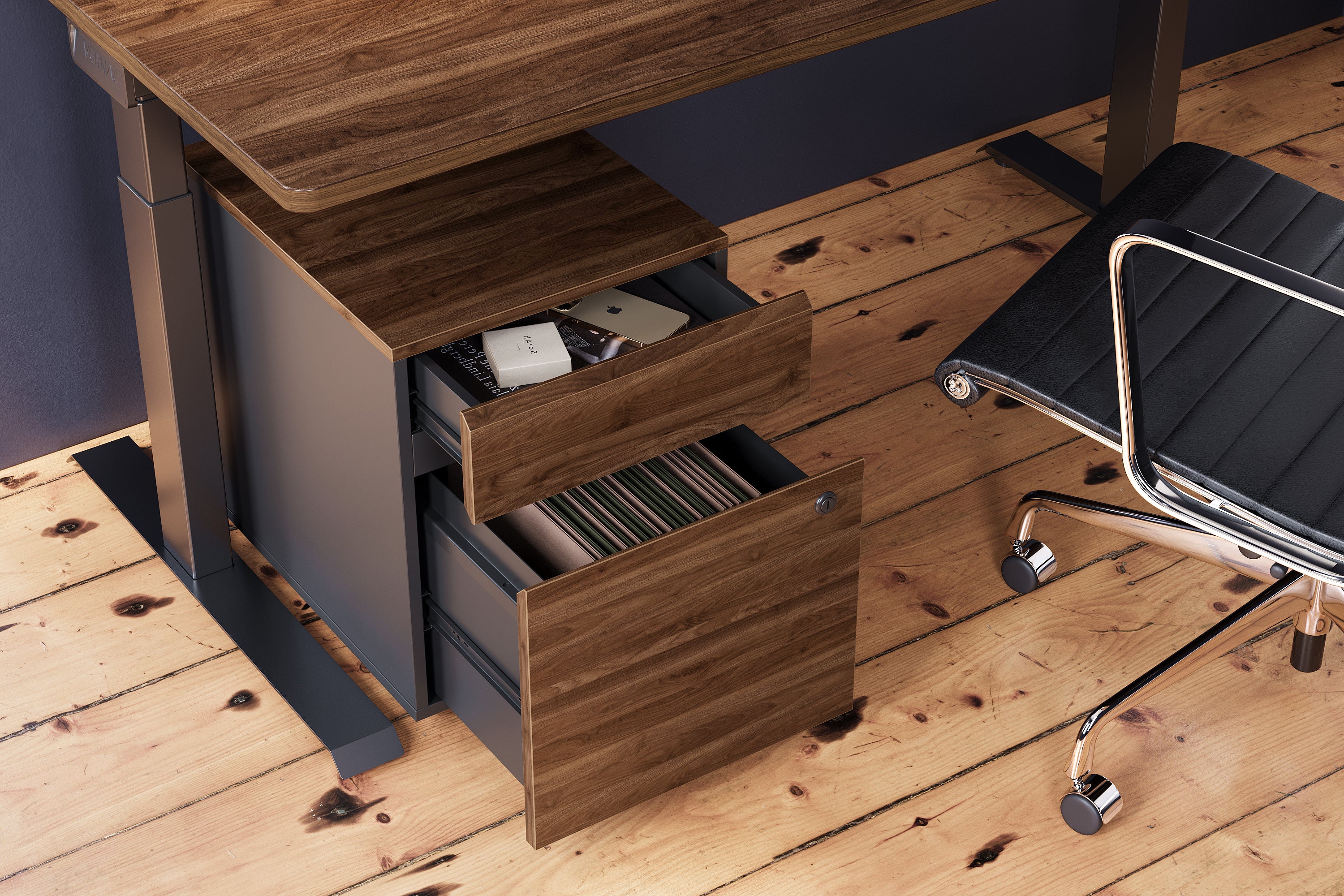
A 2 drawer file cabinet is the most ergonomic paper solution for small offices. Top drawer: stationery, chargers, sticky notes, current envelopes. Bottom drawer: suspension files.
Vernal file cabinets take A4, letter, and legal sizes, with a movable hanging bar in the base drawer. Short dimensions are compact enough to sit beside a chair or under a desk return, so you are not twisting across the room to file something.
Lockable wheels are useful here. You can pull the cabinet slightly forward, open the drawer comfortably, then roll it back. Just lock the castors once placed so the unit stays put during the day.
If you stand at your desk often, keep the filing cabinet close enough that you do not step away from the workstation to retrieve a document. That small distance change is where flow gets broken.
When a Filing Cabinet Replaces Lower Shelves
Sometimes the bottom of a bookcase is wasted space. Deep lower shelves can become awkward bending zones, especially if they hold flat files or old folders.
A better setup is to let the filing cabinet handle paper and use the lowest bookshelf row for baskets, boxes, or display volumes you rarely touch.
When choosing a filing cabinet, check drawer height as well as width. Files should stand upright, not lean. Vernal cabinets include a movable rail so the row can shift depending on whether you use slim A4 folders or chunky lever-arch files.
Tall file cabinets work in alcoves, but avoid putting daily files at the very top. The top drawer should still fall below shoulder height if you access it often.
Hiding Clutter in an Office Storage Cabinet
Not everything deserves a shelf. Routers, spare ink, cables, gift wrap, old tax years, and random tech bits create visual noise even when organised.
An office storage cabinet lets you keep the bookcase calm. Closed doors hide the clutter, while the open shelf shows only the items that make the room feel intentional.
Vernal storage cabinets include sliding file rails and come in short or tall versions. The short version pairs well under a shelf or beside a desk; the tall version extends upward with a height extender.
Ergonomically, put the cabinet within one step of the desk but not directly in your sightline. You want fast access without the doors dominating the background on video calls.
Inside the cabinet, use the same zone logic: everyday spares at mid height, heavy items low, seasonal archives high.
Compact Corners and the Small Storage Cabinet
In UK flats and box rooms, floor space is tight. A small storage cabinetk can sit in an alcove, behind a door, or beside a radiator niche.
Because the unit is compact, shelf spacing matters even more. You do not want three awkward gaps that fit nothing. Adjust the internal shelf so one row holds files flat and another holds baskets or tech pouches.
Keep the heaviest items at the base. If the cabinet is tall and narrow, fit the anti-tip kit and fix it to the wall — especially in homes with pets or children.
This piece is the secret to open shelving. The bookcase stays pretty because the ugly essentials live one step away in the small cabinet.
Building Wider Walls with Modular Shelving Units
If you have a long wall, modular shelving units let you build an ergonomic layout across several sections. Instead of one fixed case, you create zones:
- Left module: daily books at eye level
- Centre module: mix of open shelf and closed doors
- Right module: archive books and baskets low
Vernal’s modular bookcase set keeps uniform depth, so the wall reads as one piece. You can start with two or three units and expand later without mismatched gaps.
The ergonomic advantage is control. You decide where each shelf sits before the room fills up. Modular systems also let you place a closed base unit under open shelving — heavy items low, display items high, workflow in the middle.
Shelf Height Rules Worth Keeping
A few practical numbers help when setting up:
- Eye-level row: most-used books and folders
- One row below: current projects
- Bottom row: heavy items only
- Top row: decorative or rarely used
- Adjust shelves in 60mm steps where possible to match item height
Spread weight evenly. Even a strong shelf sags if every heavy binder sits in the same spot. Vernal bookcases are rated around 22.5kg per shelf, which is generous for home use, but distribution still matters.
Also avoid overfilling. A shelf stuffed to the front edge makes items harder to pull and increases the chance of something toppling. Leave a thumb-width gap at the front for easy grip.
Safety Completes the Ergonomics
Good access is unsafe if the unit tips. Tall bookcases should be fixed to the wall with the supplied anti-tip kit. Vernal includes this as standard, and it is especially important in family homes.
Place heavier items low, keep the base stable, and do not overload the top row just because it is empty. Ergonomics is not only about speed of reach — it is about a setup you can use confidently every day.
Final Thought
A bookcase is not ergonomic because it is expensive or stylish. It is ergonomic because the right item sits at the right height.
Keep daily books on the open bookcase at eye level. Move paper into a two-drawer or filing cabinet near the desk. Hide cables and spares in an office storage cabinet. Use modular shelving if the wall is large enough to zone properly.
Set the shelves once, match them to your real habits, and the office stays tidy with far less effort. That is the quiet productivity benefit of getting bookcase height right.
