

Philippines Consumer Electronics Market Size, Share, Growth & Analysis Report 2026-2034
Market Overview
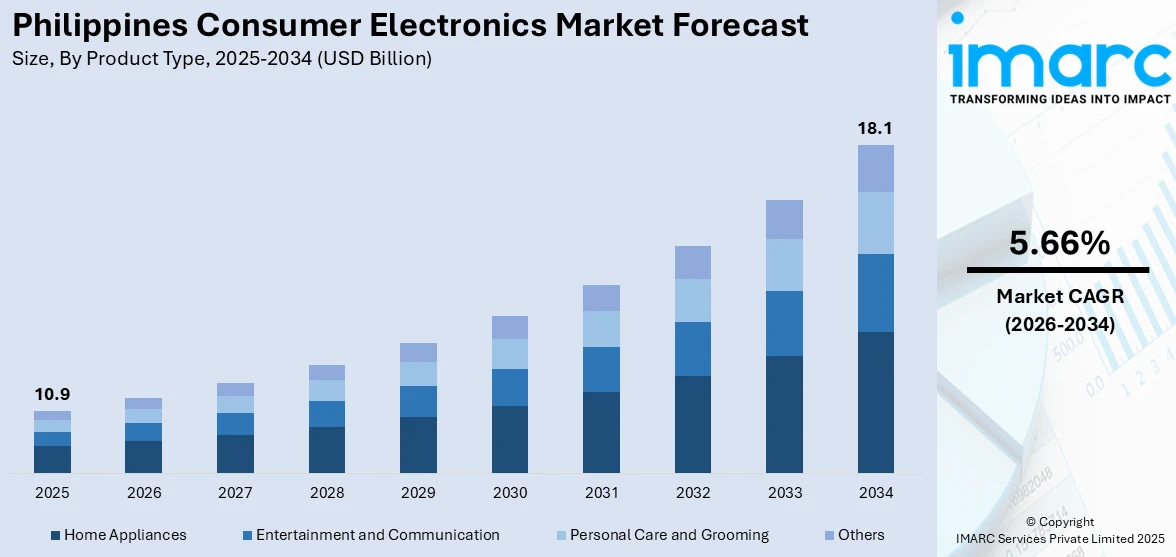
The Philippines consumer electronics market is growing steadily, driven by smartphone penetration and connectivity, interest in smart home devices, e-commerce expansion, rising disposable incomes, work-from-home and hybrid work, and a young population that adopts and upgrades devices quickly. The market size reached USD 10.9 Billion in 2025 and USD 11.7 Billion in 2026, and is projected to reach USD 18.1 Billion by 2034, registering a compound annual growth rate (CAGR) of 5.66% during 2026-2034, shaping the Philippines consumer electronics market share and outlook through 2034 across home appliances, entertainment and communication devices, personal care and grooming products, smart and conventional categories, residential and commercial use, and B2B, online, and offline channels.
Request a Sample Report for In-Depth Market Insights: https://www.imarcgroup.com/philippines-consumer-electronics-market/requestsample
Market Summary
- Mobile devices account for over 55% of consumer electronics spending in the Philippines, according to the International Trade Administration.
- About 44 million of the country's 100 million people own smartphones, and Filipinos spend about 10 hours online per day on average.
- Urban consumers are moving to mid- and high-end phones, including 5G models.
- Smart speakers, lighting, security cameras, and IoT-enabled appliances are growing in popularity.
- E-commerce platforms, flash sales, instalment plans, digital wallets, and Buy Now, Pay Later options are making devices more accessible.
- Remote and hybrid work is raising demand for laptops, tablets, monitors, routers, webcams, and headsets.
- Government digital literacy programmes, expanding internet access, and urbanisation add support.
- The market is segmented by product type, category, end use, distribution channel, and region across Luzon, Visayas, and Mindanao, with forecasts for 2026-2034.
Market Growth Drivers
Smartphone Penetration and Connectivity
Demand for affordable, feature-rich phones is strong, and urban users are upgrading to mid- and high-end models, including 5G devices. Improving connectivity increases the value of connected devices.
Smart Home Devices
Growing interest in smart speakers, lighting, security cameras, and IoT-enabled appliances is broadening the market beyond phones and TVs, supported by voice assistants such as Google Assistant and Amazon Alexa.
E-Commerce Expansion
Online platforms, including Lazada and Shopee, offer wide choice, promotions, instalment plans, and digital payment options, making it easier for consumers to buy electronics.
Incomes, Work Patterns, and Demographics
Rising disposable incomes allow more middle-income households to buy lifestyle electronics and appliances. Work-from-home and hybrid work add demand for computing and office gear, while a young population adopts and upgrades devices quickly.
Porter's Five Forces Analysis
Competitive Rivalry: High
- Global brands, regional manufacturers, and local distributors compete on price, features, design, and after-sales service.
- Frequent product launches and promotions make price and innovation key battlegrounds.
Supplier Power: Moderate to High
- Brands depend on a limited number of suppliers of chips, displays, and batteries, mostly in Asia, and imports expose the market to currency and supply swings.
- Component shortages can affect availability and prices.
Buyer Power: High
- Consumers compare prices and reviews across online and offline channels and can switch brands easily.
- Large e-commerce platforms and retailers influence pricing and promotions.
Threat of Substitutes: Moderate
- Multi-function devices, such as smartphones, can substitute for cameras, music players, and other standalone products.
- Second-hand and refurbished devices also compete with new products.
Threat of New Entrants: Moderate to High
- Contract manufacturing and online sales make it relatively easy for new brands to enter, while brand trust, distribution, and service networks favour established players.
Market Segmentation
Product Type Insights
- Home Appliances
- Large: Refrigerators, Air Conditioners, Washing Machines, Air Purifiers, Others
- Small: Microwave Ovens, Food Processors, Electric Fans, Vacuum Cleaners, Others
- Entertainment and Communication
- Televisions
- Mobiles and Smartphones
- Laptops and Computers
- Audio and Video Players
- Cameras
- Speakers
- Video Games
- Others
- Personal Care and Grooming
- Wearables: Smartwatches, Headphones, Earphones and Earbuds, Others
- Hair Care: Hair Straighteners, Hair Curlers, Hair Dryers, Others
- Beauty Devices: Face and Skin Care, Hair Removal, Nail Care, Others
- Others
Category Insights
- Smart
- Conventional
End-Use Insights
- Residential
- Commercial
Distribution Channel Insights
- B2B
- B2C Online
- Company-Owned Websites
- E-Commerce Websites
- B2C Offline
- Supermarkets and Hypermarkets
- Specialty Stores
- Other Retail Stores
Regional Insights
- Luzon
- Visayas
- Mindanao
Regional Analysis
Luzon: The largest market, anchored by Metro Manila's dense population, higher incomes, major malls, and e-commerce delivery networks. Most premium device launches, flagship stores, and tech-savvy consumers are concentrated here.
Visayas: Cebu and other urban centres have growing malls and online adoption, with demand for smartphones, appliances, and entertainment devices, and tourism and outsourcing jobs supporting incomes.
Mindanao: Davao and other growing cities offer expanding demand, with value-focused devices, mobile phones, and online shopping especially important, as incomes and connectivity improve.
Competitive Landscape
The Philippines consumer electronics market report includes global brands, regional manufacturers, local distributors, and e-commerce platforms. Competition is shaped by price, features, design, brand, availability, and after-sales service. Brands are launching new models aimed at specific consumer needs, such as music-focused smartphones, while online platforms play a growing role in distribution.
Companies and platforms referenced in market developments include:
- Nubia Philippines
- Lazada
- Shopee
- Google Assistant
- Amazon Alexa
Recent Industry Developments
November 2026: ASUS and Republic of Gamers launched the Grand Tech Fair 2026 across the Philippines, running from November 9, 2026, to January 17, 2027. The promotion includes discounts, GCash rebates, product bundles and nationwide retail events. ASUS also reported a 32.6% share of the Philippine consumer laptop market in Q3 2026, according to IDC.
November 2026: TP-Link Philippines opened its first concept store in Mindanao at Gaisano Mall of Davao. The outlet showcases Wi-Fi 7 and Wi-Fi 8 networking products, Tapo smart-home devices, security cameras and surveillance solutions. The opening expands the brand’s physical retail presence and provides consumers in the region with access to its connected-home product range.
November 2026: TCL introduced its P80 Ultra and P80 Pro smartphones in the Philippines, expanding its local mobile-device portfolio with AMOLED NXTPAPER displays and AI-enabled features. The launch extends TCL’s presence beyond televisions and home appliances into smartphones, targeting consumers seeking display-focused devices for productivity and entertainment.
November 2026: The Nintendo eShop and Nintendo Switch Online services officially became available in the Philippines for the original Nintendo Switch and Switch 2. The launch gives local users access to digital game purchases and online subscription services, strengthening the country’s access to international gaming and digital entertainment platforms.
October 2026: Philippine merchandise exports reached a record USD 64 billion during the first eight months of 2026, with electronics accounting for USD 37.1 billion, a 26.2% year-on-year increase. The government is encouraging higher-value investments in chip design, engineering and research, while Toshiba plans to expand its Philippine operations to increase hard-disk drive production.
September 2026: Electronics recommerce company 3Cat secured USD 4 million in funding to establish and expand its refurbished-device retail operations in the Philippines. The investment is intended to support inventory acquisition, product inspection infrastructure and local distribution, targeting consumers seeking more affordable smartphones and other electronic devices.
Key Aspects Required for the Philippines Consumer Electronics Market
- Market Performance: The market reached USD 10.9 Billion in 2025 and USD 11.7 Billion in 2026, and is projected to reach USD 18.1 Billion by 2034.
- Market Outlook: A 5.66% CAGR during 2026-2034 reflects steady growth driven by smartphones, smart homes, and e-commerce.
- Growth Drivers: Smartphone penetration and connectivity; smart home devices; e-commerce expansion; and incomes, work patterns, and demographics.
- Competitive Landscape: Global and regional brands, such as Nubia, compete alongside e-commerce platforms such as Lazada and Shopee.
- Industry Trends: 5G smartphones; smart home and voice assistants; Buy Now, Pay Later; and hybrid work devices.
- Strategic Recommendations: Offer affordable 5G and mid-range devices; strengthen online and instalment channels; build smart home ecosystems; and invest in after-sales service.
Note: If you need any specific information that is not currently covered within the scope of the report, we will provide the same as a part of customization.
Speak to an analyst: https://www.imarcgroup.com/request?type=report&id=28739&flag=C
Frequently Asked Questions
1. What is the size of the Philippines consumer electronics market?
The market reached USD 10.9 Billion in 2025 and is projected to reach USD 18.1 Billion by 2034.
2. What is the expected growth rate of the Philippines consumer electronics market?
The market is projected to grow at a CAGR of 5.66% during 2026-2034.
3. What is driving the growth of the Philippines consumer electronics market?
Growth is driven by smartphone penetration and connectivity, smart home devices, e-commerce expansion, rising disposable incomes, and work-from-home and hybrid work.
